Tree removal before driveway replacement in Raleigh
Tree removal before driveway replacement in Raleigh
If you are planning a tree removal before driveway replacement in Raleigh , Wake Forest, or Cary, you have more than just a paving project on your hands. Most homeowners I talk to are comparing concrete quotes and looking at decorative finishes, but they overlook the sleeping giant: the mature trees lining the old path.
Here is the reality we see on Triangle job sites: if a tree is within ten feet of your proposed driveway edge, the excavation for the new base will likely destabilize the tree, or the growing roots will crack your new concrete within 3 to 5 years. In the North Carolina Piedmont, our heavy red clay and the requirements for a stable driveway subgrade make it almost impossible for mature roots and new pavement to share the same space.
If you have a tree that seems too close for comfort, the best move is to get an assessment before the pavers arrive. You can text a photo of the tree and your driveway area to us at 919-523-8516 for an honest look. Getting this sequence right prevents you from watching a $10,000 investment buckle just a few years later.
Why driveway contractors usually won't guarantee work near mature trees
I genuinely feel for homeowners who want to save a massive oak while pouring a fresh driveway. It is a tough call. But most reputable paving contractors in the Triangle are hesitant to offer a long-term warranty if they are pouring over large roots. They know they can’t control biology. As those roots grow, they exert enough upward pressure to lift a solid four-inch slab of reinforced concrete.
Contractors also know that their heavy equipment might inadvertently kill the tree. To build a stable driveway in our Cecil red clay, they have to dig out the old surface and put down a compacted stone base. This cutting almost always severs structural roots. If the tree survives the cut, it still has to deal with 60,000-pound concrete mixers driving over its root zone. When a tree dies two years after the work is done, it’s a falling hazard, and removing it over a brand-new driveway is much more expensive and risky.
The "no-fly" zone: How close is too close for a tree and a driveway?
How do you know if your tree is a threat? In the arboriculture world, we use the Critical Root Zone (CRZ). A common rule of thumb is to estimate one foot of radius for every inch of trunk diameter. A 20-inch oak likely has vital roots extending 20 feet in every direction.
If the driveway cutting falls within ten feet of a mature tree, you are in the high-risk zone. At this distance, the excavation for the driveway base—which usually requires 4 to 6 inches of compacted ABC stone under a 4-inch concrete slab—will hit the large structural roots that keep the tree upright. Severing these doesn’t just hurt the tree; it can make it a fall risk during the next big North Carolina thunderstorm.
Structural root vs. feeder root: What happens during driveway excavation?
Our local red clay forces root systems to stay shallow to find oxygen. Most of the action happens in the top 12 to 24 inches of soil.
- Structural roots: These are the anchors. If a driveway cut severs one of these, the tree's physical stability is compromised.
- Feeder roots: These smaller roots suck up water. Paving over them doesn't just block water; the heavy equipment crushes the tiny air pockets in the clay, essentially suffocating the tree.
When a crew prepares a site, they are digging down to create a subgrade. In the Triangle, that compacted ABC stone is the only thing keeping the driveway from shifting. That stone base is totally unforgiving to any root trying to grow under it.
Why simply "covering roots" with more gravel or concrete is a recipe for failure
One of the most frequent questions we get is, "Can the pavers just pour more gravel over the roots to avoid cutting them?" It sounds like a kind solution, but it rarely works. Raising the grade around a tree smothers the root flare and prevents the tree from "breathing" through the soil.
Beyond that, a large root left under a driveway keeps growing. Even a small increase in diameter causes a heave. Once that first crack forms, water gets in, the winter freeze-thaw cycle expands it, and your investment is ruined. I’ve seen homeowners go through this cycle multiple times—eventually, they have to call for tree removal anyway, then pay a second time to repair the concrete.
The correct sequence: Removing trees and grinding stumps before the pavers arrive
If you have decided a tree needs to go, there is a specific order of operations to follow. You should never wait until the paving crew shows up to handle tree issues.
- Professional Assessment: We identify which trees are liabilities and which can be saved.
- Permit Check: In Raleigh or Wake Forest, there are rules about tree conservation, especially for street-facing trees. Please note that homeowners should verify these requirements with the city as this is not legal advice, but we can help point you toward the right UDO maps.
- Full removal and deep stump grinding : If a stump is under your new driveway, it must be ground 12 to 24 inches below the finished grade. This allow the paving crew to backfill the hole with structural stone that won't settle as leftover wood decays.
- Grading and Paving: Once the slate is clean, the pavers can build a stable subgrade without worrying about root intrusion.
Tree protection zones for the trees you decide to keep
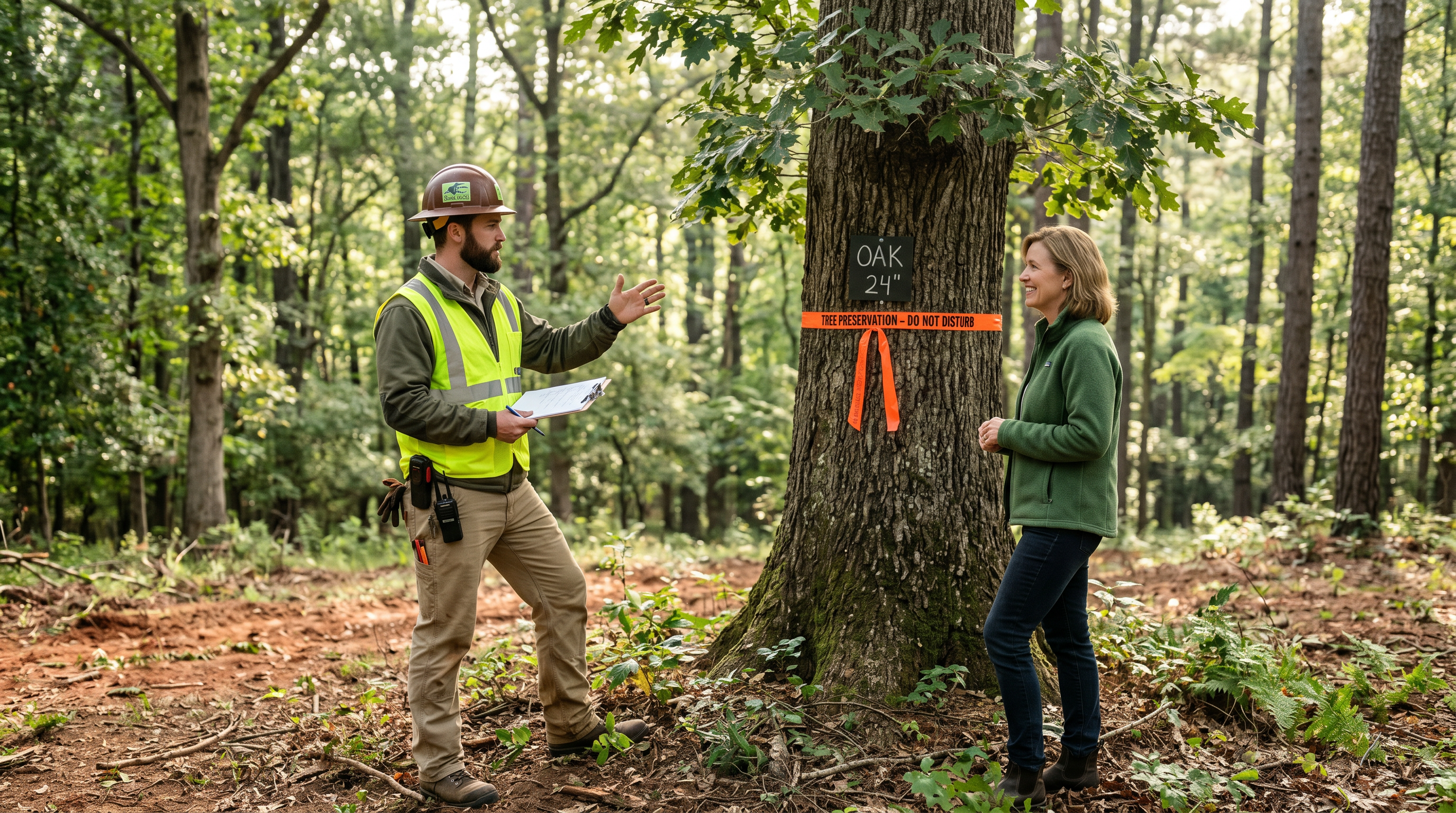
Not every tree near a project has to come down. If you want to keep one, you must be proactive. We recommend installing protective fencing around the CRZ before heavy machinery arrives. Even one pass by a dump truck over wet clay can cause permanent damage to a tree's health. Make it clear to your contractor that the root zones for trees in Apex, Cary, or Raleigh are off-limits for driving or storing stone and sand.
Getting an estimate for your pre-driveway tree work in the Triangle
A new driveway is a major improvement for your home. You want it to last for decades. Taking care of tree issues before the concrete trucks arrive is simply the best way to protect that money.
Wake Tree Removal has worked alongside homeowners and contractors in Raleigh, Wake Forest, Cary, and Apex to ensure these projects go smoothly. We focus on clear communication and ensuring your lawn and existing hardscapes stay protected while we work.
If you are planning your project now, contact us for a free estimate. You can also text photos of your trees and driveway project to 919-523-8516. We can often give you a sense of what needs to happen just from a few clear pictures, helping you keep your project on schedule.
Share
You might also like