Selective tree removal for sunlight in Wake Forest and Raleigh: Risks and rewards
Selective tree removal for sunlight in Wake Forest and Raleigh: Risks and rewards
Many homeowners in the Triangle move into beautiful, wooded subdivisions in Wake Forest, North Raleigh, and Cary only to realize later that they cannot grow a lawn or enjoy their backyard because of heavy shade. While clearing space for a pool or a garden is a common goal, taking out trees in a dense stand isn't as simple as picking a few you don't like. Removing the wrong ones can leave the remaining trees at a much higher risk of falling during a storm.
Key takeaways for backyard thinning
- Sunlight requirements: To grow Tall Fescue, you need at least 4 to 6 hours of direct sun. Bermuda grass needs 6 to 8 hours.
- Windthrow risk: When you remove trees from the middle of a dense cluster, the remaining trees lose their "wind buffer" and are more likely to blow over in high winds.
- Soil matters: The heavy red clay in the Raleigh area holds water, which makes tall, isolated pines more prone to uprooting when they are suddenly exposed to the wind.
- Edge trees are safer: Trees on the outer edge of a wooded area are usually more wind-resistant than those grown in the crowded interior.
Understanding the science of windthrow
When trees grow together in a tight group, they develop differently than a single tree in an open field. In a forest or a dense backyard buffer, trees lean on each other for mutual support. Their canopies interlock, which slows down the wind, and they often have shallower root systems because they don't have to fight the wind alone. This is particularly true for Loblolly pines, which are everywhere in the Triangle.
If you remove several trees from the center of this group to let light in, you create a "sail effect" for the trees that are left behind. These remaining trees now face full wind loads they haven't been built to handle. Studies indicate a heightened short-term risk until the trees have a few years to grow thicker trunks and deeper roots. We see this often after hurricane remnants pass through North Carolina; the trees that fall are frequently the ones that were recently left standing alone after nearby clearing.
How much sun do you actually need for grass?
Before you commit to tree removal in Wake Forest NC , it helps to know what your landscaping goals require. Our local climate in the Piedmont is a transition zone, meaning we can grow both cool-season and warm-season grasses, but they have very different light needs.
Tall Fescue is the most popular choice for wooded lots in the Raleigh area because it can handle partial shade. However, "partial shade" still means a solid 4 to 6 hours of direct sunlight. Without adequate light, grass struggles despite other care. Bermuda and Zoysia are even more demanding, often requiring 6 to 8 hours of full sun. If you want a lush, green lawn, we usually have to look at removing specific trees that block the southern and western afternoon sun.
Selective clearing vs. clear-cutting
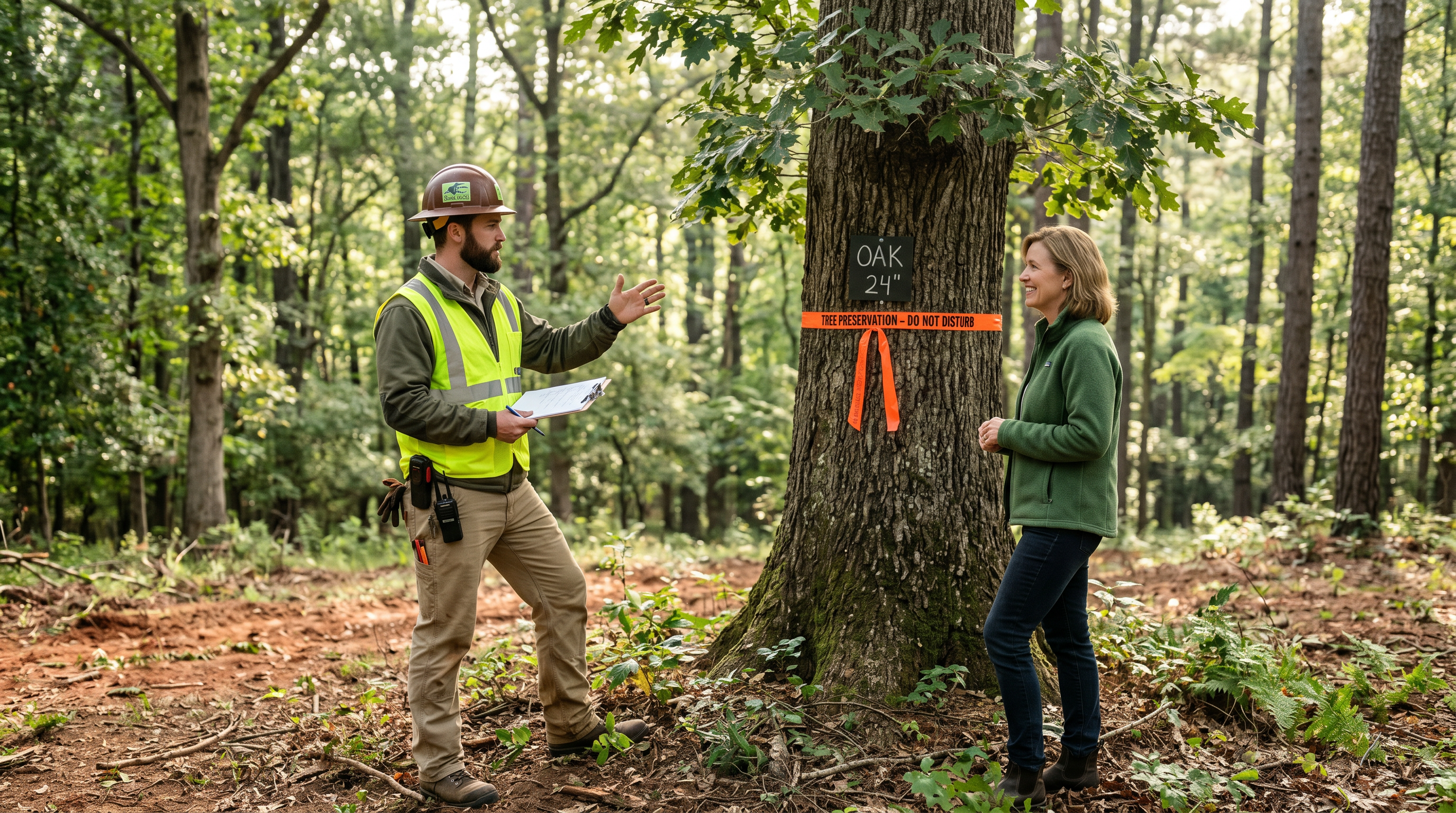
We generally advise against clear-cutting a backyard unless you are preparing for a major construction project like a pool or an addition. Selective clearing is often a better approach. This involves identifying the specific trees that are either hazardous, dying, or blocking the most light, while keeping the healthy "edge" trees that provide privacy and wind protection.
When selecting which trees to keep, we look for "taper." A tree with a thick base that gradually thins out as it goes up is much stronger than a tall, spindly tree with a tiny tuft of needles at the top. Keeping these stronger, shorter trees while removing the tall, thin pines can give you the light you want without creating a hazard for your home or your neighbor's fence. If you aren't sure which ones should stay, you can contact us for a professional assessment.
Dealing with stumps and the red clay
Once a tree is down, the job isn't quite finished if you plan to plant grass. Pine stumps and large hardwood roots can take decades to rot on their own. For homeowners wanting a lawn, stump grinding is a necessity. We grind the stumps deep enough so that you can add topsoil and seed directly over the area.
In our area, the soil is often heavily compacted red clay. After we finish the tree work and stump grinding, the soil is usually too hard and acidic for grass to thrive immediately. You will likely need to aerate the ground and add lime to balance the pH before you put down seed or sod. Taking care of the soil is just as important as getting the sunlight right.
Permits and HOA rules in the Triangle
Before any work starts, you should check your local rules. In many parts of the Raleigh area, you don't need a city permit to remove healthy trees on your own residential property for sunlight. However, there are exceptions. If your property has a protected "buffer zone" or is part of a conservation easement, there may be strict limits on what you can cut. Most importantly, check your HOA bylaws. Some neighborhoods in Wake Forest and Cary are very specific about how many trees must remain on a lot or what species can be removed.
How to get a quick estimate
If you are tired of a dark, muddy backyard and want to see what is possible, we can help. You don't always need to remove every tree to get the results you want; sometimes a mix of removal and strategic trimming is the best path forward.
The fastest way to get started is to take a few wide-angle photos of your backyard from your back porch or door. Text those photos to us at 919-523-8516 . We can often give you a rough estimate and point out which trees might be candidates for removal and which ones should stay for the safety of your property. We serve homeowners across Wake Forest, Raleigh, Cary, and the surrounding Triangle communities, and we make sure your yard is cleaned up and your property is protected during the whole process.
Share
You might also like